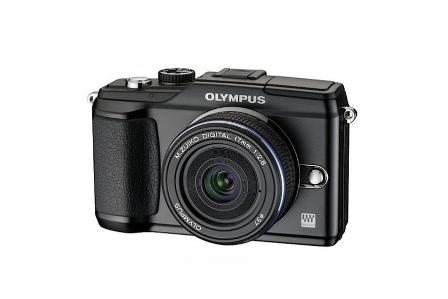
Olympus Pen E-PL2 Camera Announced Jan 5th, 2011
Fisheye, wide-angle and macro lenses announced
The Olympus Pen E-PL2 camera is a new micro-thirds camera that upgrades the Olympus E-PL1. The changes made to the E-PL1 are quite minor. More exciting are the new inexpensive accessory lenses announced.
Olympus E-PL2 highlights:
- 12.3 megapixel Micro-four thirds sensor, same as the E-PL1 sensor
- Kits lens is new silent-focus 14-42mm lens. The previous lens was a little noisy while auto-focusing.
- 460,000 dot LCD increased the resolution over the E-PL1 LCD. The E-PL1 had a 230,000 dot LCD, which some people didn't like
- Highest ISO has been increased from ISO 3200 to ISO 6400
- Grip has been improved over the E-PL1, and a control wheel has been added
- Max shutter speed increased from 1/2000th to 1/4000th – this will be a very welcome improvement when shooting into bright light
- Available at the end of Jan 2011 for $599
Here is our Olympus E-PL1 review for topside and underwater use. Since the E-PL2 has only minor changes, everything in the E-PL1 review will apply to the E-PL2.
Here's the official press release from Olympus.
Accessory lenses:
- Fisheye Lens – $170 – $199 retail, increased field of view to 120 degrees. An important question will be whether a port is offered that supports this accessory.
- Wide-angle converter, increases field of view. Effectively changes 14mm lens to 11mm – $99
- Macro Lens – allows closer focus distance – $59
The accessory lenses will bayonet onto the end of the new 14-42mm lens.
New Olympus E-PL1 PT-03 Underwater Housing
The new PT-03 Underwater housing looks quite similar to the Olympus underwater housing for the E-PL1. Since the button layout of the E-PL2 has changed, the old housing will not work with the new E-PL2, and vice-versa.
Wide-angle lens options
The Panasonic 8mm fisheye lens is an excellent wide-angle lens choice for this camera, for underwater use.
About Micro-four thirds cameras
- Allows interchangeable lenses like a dSLR
- Very small, compact size due to not having a mirror, hence they are called "mirrorless" cameras
- Take photos via live view instead of a viewfinder
- Large sensor size means great image quality. Sensor has a crop factor of 2.0
- No mirror means auto-focus is faster than compact cameras, but not always at the level of a dSLR
- Read our complete overview of mirrorless cameras
Further Reading
Olympus PEN E-PL1 review
Olympus XZ-1 camera announced
Lens and Camera basics
Support the Underwater Photography Guide
Purchase your Olympus Cameras and Housings at our sister company Bluewater Photo, or call us for free advice.